Your patients have unique cancers.
Now we treat them that way.
GAMGEE designs a personalised mRNA cancer vaccine from each patient's own tumour DNA. You stay in the clinical driver's seat. We handle the science, from sequencing to delivery.
first documented case
vaccine in hand
vaccine design review
required from your team
Ready to refer a patient?
Share your patient's contact details and a brief case summary. We reach out to the owner directly. You do not need to manage the conversation from there.
What to include
- Your name, clinic name and direct contact
- Dog's name, breed and age
- Diagnosis, stage and prior treatments attempted
- Owner's name and contact information
What happens next
- We review the case and confirm eligibility
- We contact the owner directly to walk them through the process
- If accepted, a biopsy kit ships to your clinic
- You receive updates at each stage
Three things we need from you.
Most of your involvement happens in steps you are already performing. We are built to fit inside your clinical workflow, not change it.
Refer the case
Submit a brief case summary: diagnosis, stage and prior treatments. We review the case and confirm eligibility before anything else moves.
Collect biopsy samples
A prepaid kit ships to your clinic. During the procedure you were already planning, drop in a tumour sample and a matched blood draw. Ship it back the same day.
Administer the vaccine
The finished vaccine arrives cold-chain labeled with a printed dosing schedule, including dog name, dose number and date window. You administer under your existing clinical judgment.
 Whole-exome sequencing
 AI neoantigen analysis
 mRNA vaccine design
 GMP manufacturing
 Cold-chain delivery
 Outcome monitoring

You make the final call on every vaccine design.
Before we proceed to manufacturing, you receive a full design report showing every candidate neoantigen, its confidence score and what including or excluding it means for the final sequence. Most reviews take under 20 minutes. The report is yours to keep regardless of whether you proceed.
From referral to vaccine, approximately four weeks.
Indicative timings based on our first case. We share a more precise estimate with each referral once we have reviewed the case.
These are indicative timings from a single case. Sequencing turnaround and manufacturing schedules may vary. We will give you a case-specific estimate before proceeding.
Each vaccine is built from
the tumour's own blueprint.
Every tumour carries mutations that healthy cells do not. These mutations produce surface markers called neoantigens, flags that exist only on cancer cells. We read those flags, encode them into mRNA, and give the immune system a precise target list.
Sequence the DNA
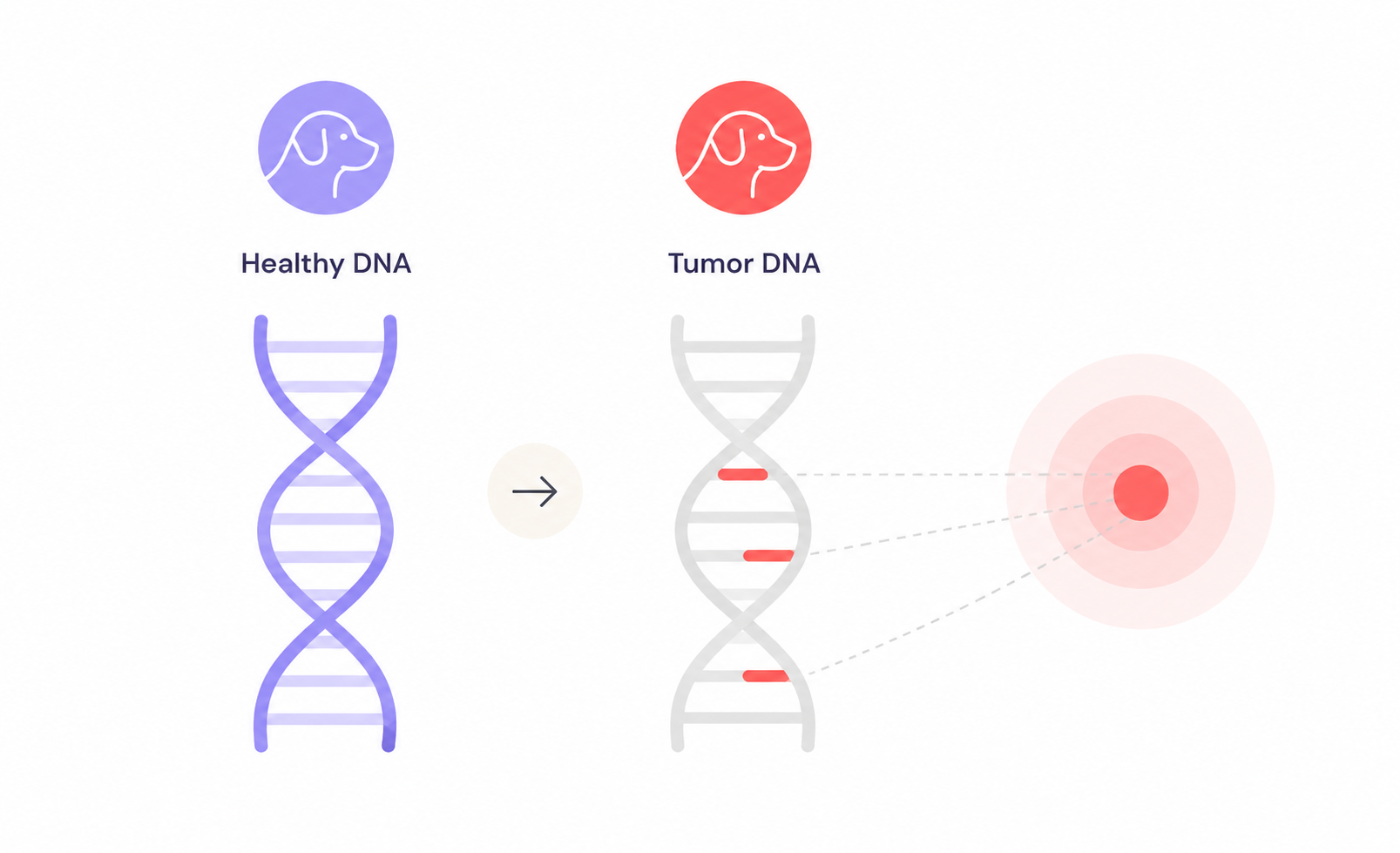
Tumour DNA is compared to healthy blood sample DNA.
Unique mutations become the targets
Find the targets
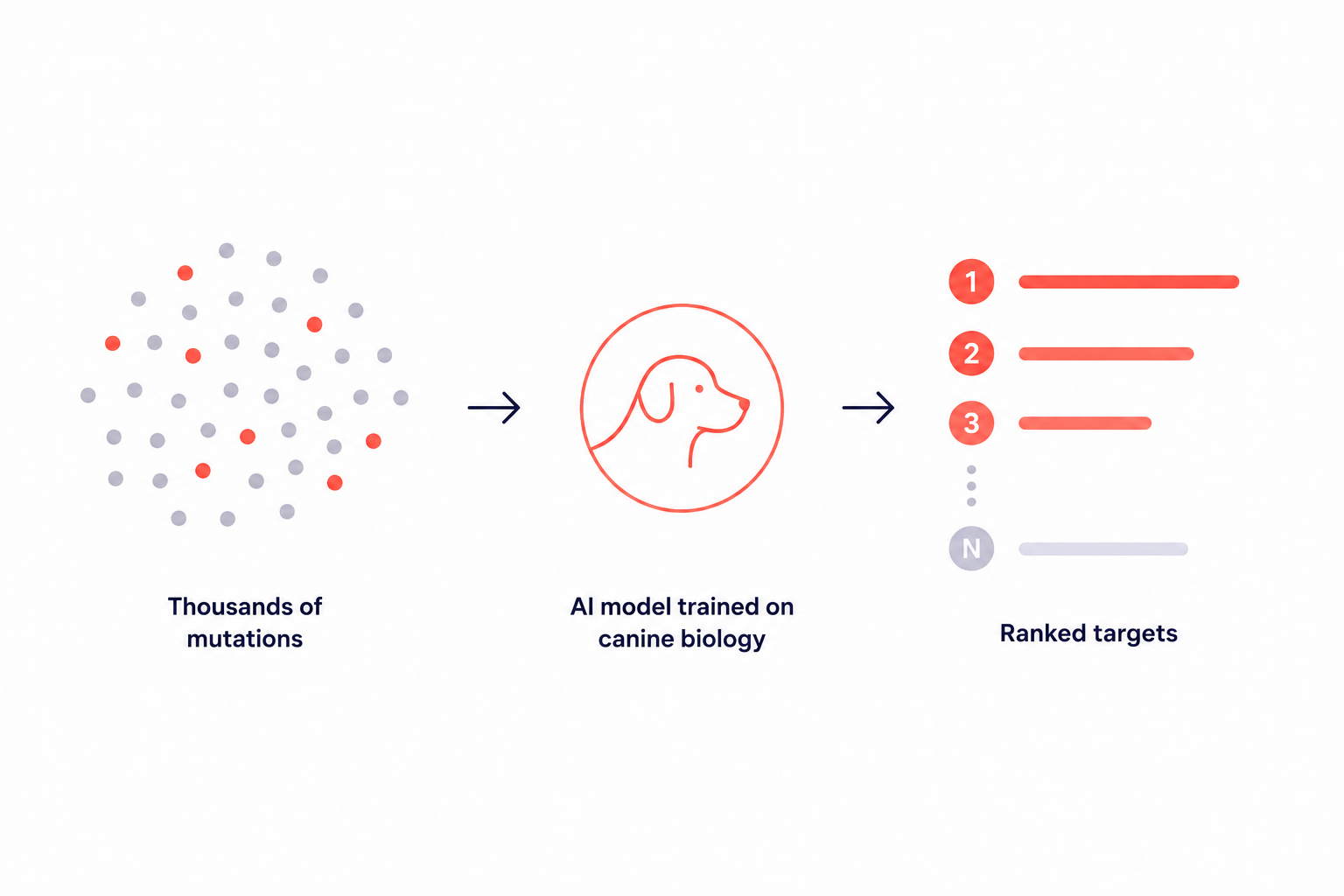
Thousands of somatic mutations ranked by binding affinity and immunogenicity. Models trained on canine biology, not human
Train the immune system
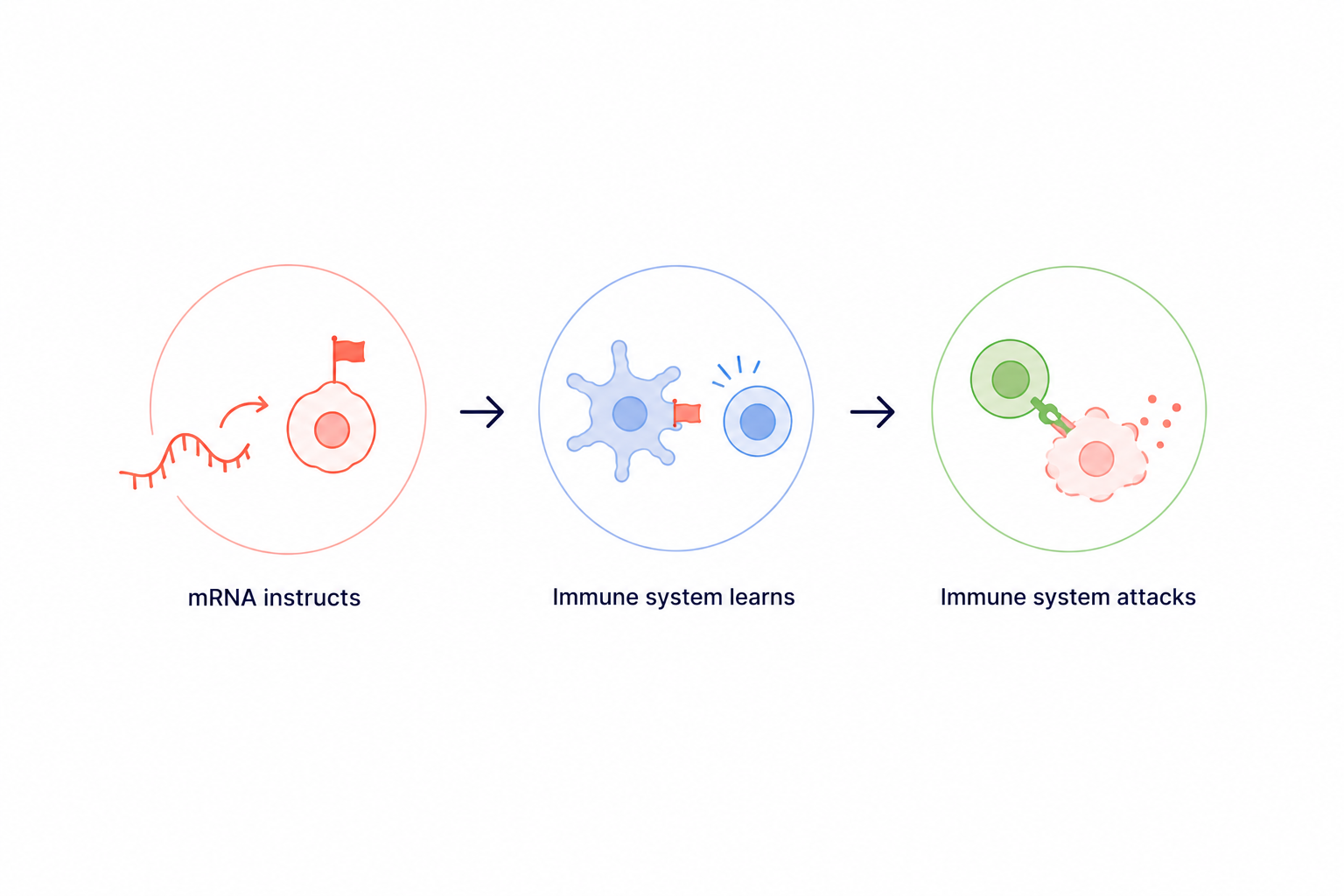
mRNA instructs the dog's own cells to display the neoantigen flags briefly. Immune system learns the target and attacks
Whole-exome sequencing
We compare DNA from the tumour biopsy against a matched blood sample. Only mutations present in the tumour, absent from healthy tissue, are candidate targets. Everything else is filtered out from the start.

Neoantigen prioritisation
Our pipeline runs binding affinity predictions and immunogenicity scoring across all somatic mutations, using models trained on canine biology. The highest-confidence candidates are ranked and surfaced for your review before any manufacturing begins.

mRNA delivery
Selected neoantigens are encoded into a codon-optimised mRNA sequence built for canine cells. When administered, the patient's cells briefly display cancer-specific markers, activating a targeted T-cell response directed only at tumour cells.